Most scheduling comparisons are framed the wrong way. They compare features.
The better comparison is: what job was each tool built to do?
Spreadsheets: Maximum Flexibility, Minimum Structure
Spreadsheets survive because they are adaptable. If a chief resident or coordinator is smart enough, they can force a spreadsheet to represent almost anything.
That is also the problem. The logic tends to live in the person, not in the tool. The file becomes powerful and fragile at the same time.
Amion: Publishing, Not Solving
Amion has always been clear about its real strength. It gives physicians a place to look up the schedule.
That is a useful job. It is just a narrower job than most departments eventually need. If you still create the schedule somewhere else, track the real rules somewhere else, and handle changes somewhere else, then the viewer is only one layer of the system.
QGenda: The Enterprise Answer
QGenda sits on the other end of the spectrum. It is designed for organizations that want a broad administrative platform: schedule creation, rules, approvals, reporting, and integration.
That is often the right answer for large systems. The tradeoff is weight. When a product tries to solve the whole enterprise problem, it usually stops feeling light to the people who just want to know where they are working and who is on call.
Where We Think The Gap Is
The gap we care about is the space between publishing and enterprise management.
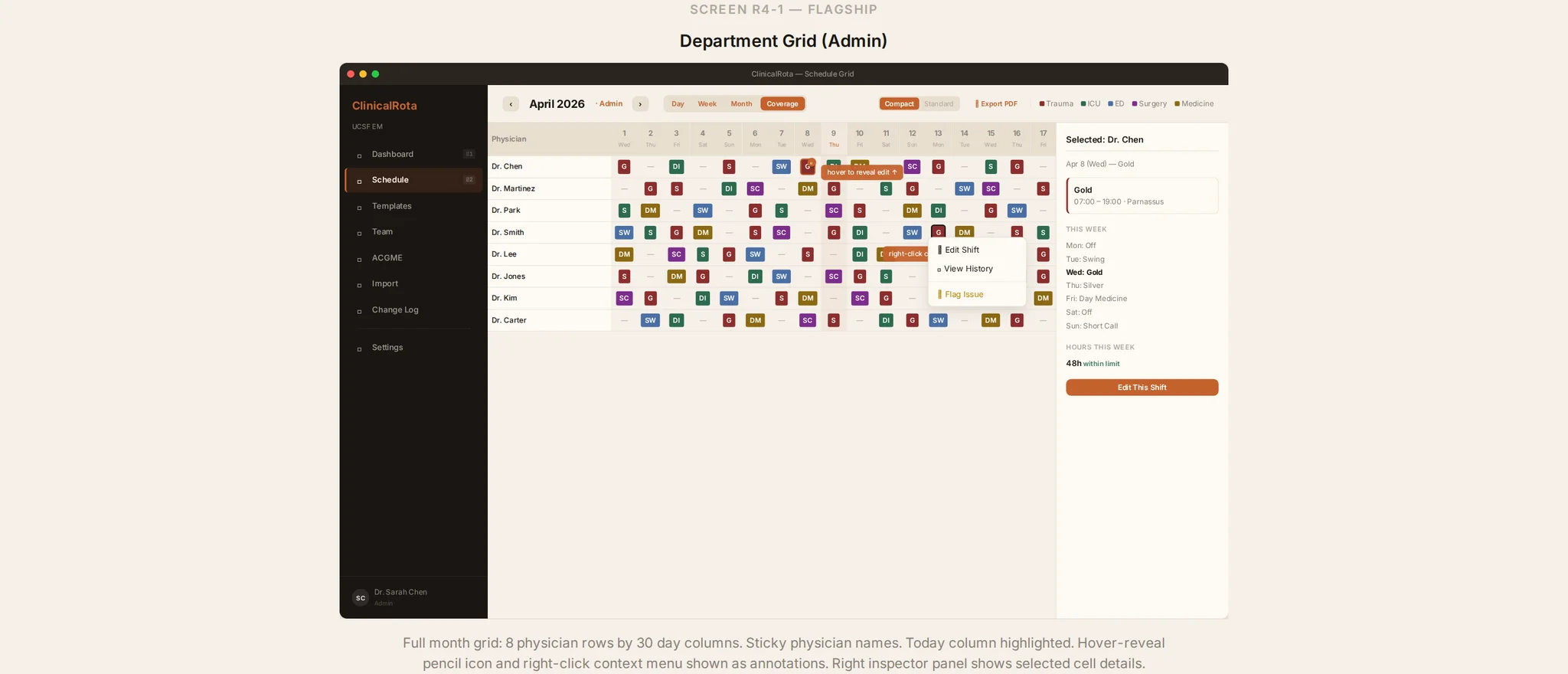
There are a lot of departments where the schedule technically exists, but the day-to-day experience is still bad. Physicians cannot see the shape of the month. Contact lookup is clumsy. Change history is murky. The scheduler understands the logic, but the group does not.
That is the problem Clinical Rota starts from.
What Clinical Rota Actually Is
Clinical Rota is early. It is not a mature scheduling platform yet.
That matters, because we do not want to fake certainty. The current direction is our way of testing a thesis: that a much better viewing and transparency layer would already solve a meaningful part of the pain, even before deeper automation enters the picture.
So the honest comparison is not “Clinical Rota versus QGenda” as if the tools all start from the same premise. Existing products optimize for different things, and Clinical Rota starts from a different point of view.
How To Choose Honestly
If spreadsheets are good enough and the pain is low, stay there.
If you mostly need a place to publish a finished schedule, a viewer may be enough.
If you need heavy administrative control across a large enterprise, an enterprise platform may be worth the weight.
If your actual complaint is that physicians still hate interacting with the schedule, then the problem is not fully solved yet. That is the gap Clinical Rota is trying to understand.
If this gap sounds familiar, see the sneak peek. We will walk through the current direction, learn how your current stack actually works, and decide what the first version should do.